July 2026
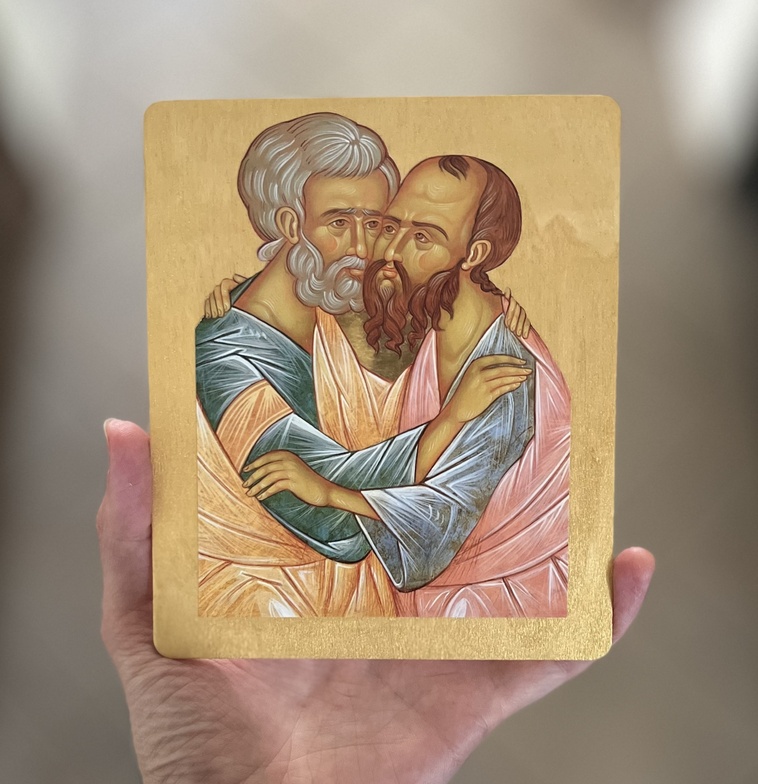
Feast of the Apostles
For thee to live is Christ, and to die is an excellent acquisition; for through love thou wast crucified with Him Who was crucified for our sake, O most glorious Paul.
- Ode 5 -
Fill my tongue with light, O my Savior, and having enlarged my mouth and filled it, have pity on my heart, that I may speak, follow, and teach that which I should first do; for Thou didst say that he who doeth and teacheth is great. For if I speak only, and act not, I am accounted as sounding brass. Wherefore, grant that I may speak fitting things and do that which is profitable, O Thou Who alone knowest the hearts of all mankind.
- Ikos of Ode 6 -
The hymns commemorating the Apostles Peter and Paul richly demonstrate that apostolic Christianity is neither about high theology and knowledge, nor is it a program for social change. Rather, it is the reign of the King within the human heart, which then flows out into the world in holy prayers, worship, theology, and deeds of love that transform the world into the Kingdom of God.
Central to the patristic writings is what Jesus first proclaimed at the beginning of His ministry: the coming of the Kingdom of God. In Christ, the age to come has already appeared on earth, for He transcends all time and space. Therefore, when Christ is formed within the human spirit, soul, and body, the sanctified person also becomes a vessel of the age to come. Heaven and earth are reunited wherever Christ is, and Christ reigns in heaven, but He also desires to reign in the humble and contrite heart.
The Fathers had a keen awareness of Jesus’ words that ‘the Kingdom of God is within you.’ Since Adam was granted royal authority over earth, the pure heart is the vessel through which Christ is able to reign on earth. Heaven and the heart are the “headquarters” of the Kingdom of God (Isaiah 57:15). If we desire to see the Kingdom manifested on earth, then the task set before us is to be very attentive to all the movements, motives, desires, and thoughts of the heart.
Sin, by contrast, desires to “reign” in the heart, for the evil principalities under the "prince of the world" reign on thrones of sin within the human members. Apostle Paul understood this mystery very well. The Christian has indeed died with Christ to sin. However, they must not let sin “reign” in their members (Rom 6:12). The Christian has been crucified with Christ, but aims to be able to practically say with Apostle Paul in Galatians 2:20: ‘I have been crucified with Christ; it is no longer I who live, but Christ lives in me; and the life which I now live in the flesh I live by faith in the Son of God, who loved me and gave Himself for me.’
The Apostles Peter and Paul died to their earthly desires, their old mindsets, and their pursuit for self-righteousness. They both came to know the depth of their fallenness, but also the ever-deeper love of God. They surrendered themselves entirely to the mercy of the Chief Shepherd (1 Pet 5:4), girding up the “loins” of their minds and setting their hope entirely on the grace to be brought at His coming (1 Pet 1:13).
Can we, too, strike this apostolic balance of fully trusting in the mercy of God and the grace to be brought at His coming, while also girding up the “loins” of the mind and embracing His cross that it might be He who lives in us, and no longer us? Can we come to the point of saying with Apostle Paul: ‘To live is Christ, and to die is gain’ (Phil 1:21)? With that kind of heart, every thought, word, and deed can become an opportunity for heaven to be brought on earth, and for the Kingdom to come.